Wednesday, October 24, 2012

Gold Strike


An exhibition about the Waihi gold strike of 1912.

This exhibition will be opening at Waihi Arts Centre and Museum on Sunday November the 11th and running until to the 25th of November. It will then show at The Rotorua Museum from 13 April – 30 June 2013, and then at Whitespace Gallery, 12 Crummer Rd. Ponsonby, Auckland during July 2013.
Gold Strike is an imaginative reconstruction of the 1912 Strike - The people, places and the locations of this vivid, violent and ultimately tragic event. The exhibition will be opened exactly 100 years to the day that the striker Fred Evans was killed as he fled from the miners Union Hall on the 11th of November 1912.

The Pukewa workings
122 x 60
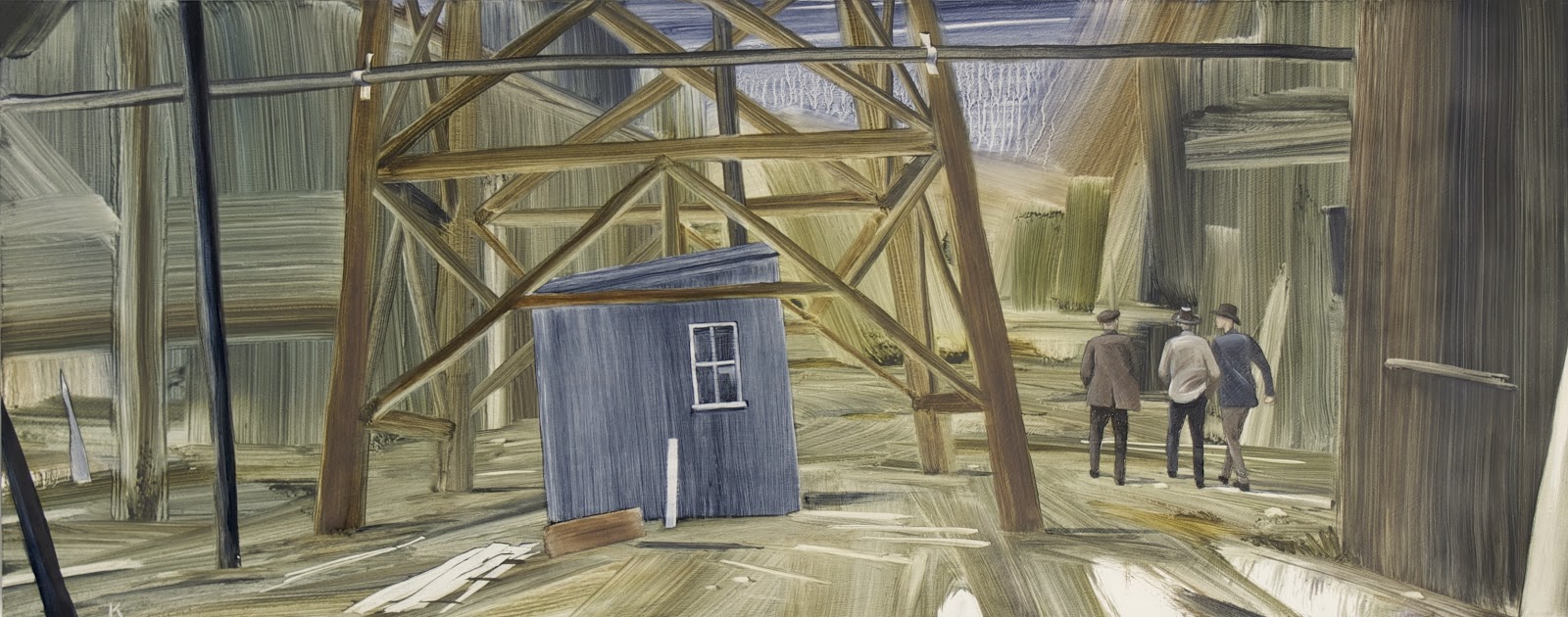
The first prospectors to explore the Waihi workings, McCombie and Lee, bored into Pukewa’s harsh, glinting interior.
The open cut
180 x 60
There in Waihi, with its toil and its treasure,
Men’s lives are squandered while earning a crust.
The Talisman Battery

122 x 90
Several deafening batteries of stampers began crushing the quartz rock down to powder.
The Orua flax swamp
63 x 25
Tim Armstrong left school at the age of 11 and worked in the flax-milling industry in the great Orua flax swamp between Bulls and Shannon.
The fun of the world

63 x 25
At 19 Tim Armstrong was working on the railway in Raetihi when he heard of work available the Waihi goldfields. " I thought it would be the place for me, so along with a few mates we made up our minds to roll up our swags and walk to the gold fields… it was the fun of the world at times.”
The Golden Cross mine

63 x 25
At Waihi, Tim Armstrong found work at the Golden Cross mine.  “There they had a union and it was the very thing I wanted.” In no time at all Tim was president of the large Waihi Miners Union.
Bill Parry
180 x 45
The Waihi Miners Union managed to retain a president by paying his salary themselves, and Bill Parry proved his worth during fierce negotiations with the mining company over competitive contracting.
The Rebel
40 x 60
Charles Smith was a “Niagara of Energy”. He was a miner, the president of the local branch of the Socialist Party, the author of frequent articles on Waihi, under the pen-name ‘The Rebel”, and the organiser of Pat Hickey’s 1911 campaign for the parliamentary seat of Ohinemuri.
Pat Hickey
Private collection

By 1911 this ‘roaring boy’ from the Federation of Labour was one of the country’s most powerful political orators. The Waihi socialists selected him as their candidate for the 1911 general election.
Bob Semple
Private Collection

Known as ‘Bob the Ranter, a former tunneller and one of the country’s prominent apostles of socialism, Semple helped to campaign for Hickey in Waihi.
Paddy Webb
Private collection
While Hickey ran for parliament in Waihi, Paddy Webb was the miners’ choice in Runanga on the west coast. Neither man won in 1911, but in 1913 Webb won a by-election to become the first coalminer to enter parliament.
Harry Holland

55 x 40
Harry was a silver-tongued Australian radical who was invited to New Zealand by the Waihi socialists to give a speaking tour. He stayed here for the rest of his life and became leader of the Labour Party.
Marjorie Noakes

55 x 40
A schoolgirl and miner’s daughter who, like Zena Norton, was passionate about the principles of her father’s union. “Why should men who work the hardest get the smallest pay, and those who do not work at all get millions of money?”
The mine manager’s dream
122 x 90
With the water level rising in the mineshafts and returns falling for the first time in a decade, industrial conflict threatens to overwhelm the diggings and the embattled mine manager sleeps uneasily.
Two on the beats and one in the watchhouse
Three panels, each panel
17 x 26
“Since the Strike commenced, there have been three Constables on night duty, two on the Beats and one in the Watchhouse.” 
The police inspector’s report

55 x 40
“I beg to report that ever since the Strike commenced… not one act of lawlessness of any kind has been committed”
The Cornish Pumphouse
120 x 90
This concrete castle housed the massive pumps that kept the mines free of water. During the strike they fell silent, and several strikers slipped underground to check how high the water levels had risen.” 
Rev. Robert Cleary
55 x 40
The local Anglican minister was one of several Waihi notables who signed a letter calling for the government to intervene in the strike. He was later made an honorary member of the scab union.
Commissioner Cullen
90 x 90
An iron-willed Irishman who rose from constable to Commissioner of Police, Cullen was prepared to break his own laws to defeat Waihi strikers and other ‘enemies of society’.
Bully boys and ex-cons
55 x 40
“the peace of Cullen the Police Commissioner and Herdman the voice of Justice, who sent in extra cops, scabs, bully boys and ex-cons”
The Snakecharmer
55 x 40
If there was trouble in Seddon Street, Waihi’s main thoroughfare, the sinister bowler-hatted strikebreaker known as the Snakecharmer was always there.
Harvey the Pug

55 x 40
The vicious ex-criminal recruited to help break the strike, he rode into town firing a pistol in each hand.
Hatpin Delaney
55 x 40
The blustering strikebreaker who gained his nickname after he was chased by 18-year-old Jessie Beames, armed only with the nine-inch hatpin she pulled from her cascade of chestnut hair.
The brakes

120  x 90
Strikebreakers were transported to and from the mine in open horse-drawn carriages, known as brakes. Sometimes a uniformed policeman held the reins. On every shift they faced a barrage of abuse from strikers and their families.
The Death of Fred Evans
32 x 23
Evans then fled in terror through a back door and into a vacant property behind the hall. “My father always said that he survived,” says Don Boswell, “because he could run faster than Fred Evans.”
Michael Rudd

55 x 40
The turncoat from the strikers’ ranks who compiled a list of his former colleagues. The strikebreakers worked through the list, giving each man and his family a day’s notice to be on the train out of town.
Georgina Parry
13 x 15
Georgina Parry, wife of the imprisoned union president, was threatened by a mob. “I said if they were men enough to attack me, I was woman enough to fight them.” 
Peter Fraser
55 x 40
The earnest Scot from the Federation of Labour who got Bill Parry released from Mt. Eden gaol. Like others prominent in the strike, Fraser entered parliament 20 years later.

The Scarlet Runners
120 x 40
Private Collection

The strikers’ sweethearts, wives and sisters who ran messages through police lines and later slipped into the besieged town to distribute relief supplies. 
The Taniwha
112 x 20
The river steamer that sailed between Paeroa and Auckland, carrying strikers, strikebreakers and gold. In November 1912 it transported the terrorised strikers’ families to safety.

The quotations with each painting are from “Waiheathens – Voices from a mining town,” by Mark Derby and Bob Kerr. A book that accompanies this exhibition. This book can be bought from the Waihi Gallery or from the publisher, Atuanui Press. atuanuipress.co.nz

The paintings are all oil on board. Their dimensions are in cm, width before height. If you are interested in purchasing any of these paintings please contact:
54 Kenny St Waihi 
Box 149 Waihi 3641
Phone 07 863 8386
Email: wacma@waihimuseum.co.nz

When they are showing in Rotorua and Auckland please contact:
12 Crummer Rd. Ponsonby
Auckland, New Zealand
Phone : +64 9 361 6331
Mobile: +64 21 639 789.
The show will travel in its complete state and works purchased from Waihi or Rotorua will be delivered at the conclusion of the showing at Whitespace in July.

Sunday, April 22, 2012

Hell Here Now - The Gallipoli diary of Alfred Cameron at Whitespace Contemporary Art


Whitespace is at 12 Crummer Road, Ponsonby, Auckland. The weekly opening hours: Tues to Fri 11-6pm | Sat 11-4pm. These new paintings about Alfred Cameron show his journey from his uncle’s farm at Culverden to Gallipoli. They will be on display at the Gallery until the 5th of May.

1  Leaving Culverden. 78 x 9 cms.
Alfred Cameron was working on his uncle’s farm at Culverden in North Canterbury when war was declared. He began his daily diary on the 13th August 1914 with the words, ‘Enlisted for first New Zealand Expeditionary Force to European War.’
2  Left Wellington at 6.30 a.m.  Eleven panels. Each panel 38 x 100.
On the 16th of October ten troop transports and their naval escorts steamed out of Wellington Harbour past a landscape that looked strangely like Gallipoli. Alfred Cameron was on board the Tahiti.
3  Saw camels for the first time. 180 x 40.
On the first of December Cameron sailed through the Suez Canal. He wrote in his diary about seeing camels for the first time.
4  There was scenery and doings en-route of much interest and novelty. Three panels, each panel 16.5 x 26.
The New Zealand troops disembarked at Alexandria and moved to a camp in the desert near Cairo.
5  A strange Christmas in the east.  24 x 34.
On Christmas day 1914 Cameron described a trip to the Pyramids.
6  The sea is very smooth and also very blue.  Four panels, each panel 40 x 38.
In early May Cameron writes, ‘Great news, off to the Dardanelles on Sunday.’ This was a four-day journey on the steam ship Grantully Castle.
7  Hell Here Now.  Ten panels. Each panel 60 x 120.
Cameron kept his diary for three weeks on Gallipoli. The last words he wrote at the end of May were, ‘Dam the place no good writing any more.’
8  Return to Cricklewood. 68 x 20.
In July Alfred Cameron was wounded and evacuated to a hospital in Cairo. He returned to New Zealand and became a farmer near Cricklewood in South Canterbury.

The paintings are all oil on board. You can contact White space here or by ringing 09 361 6331


Saturday, October 22, 2011

"The Rocky Barron Hills," opens at Suite Gallery, Oriental Bay, on Thursday 24th of November

In May 1826, Thomas Shepard, a young draftsman stood on the deck of  Captain James Herd's barque Rosana and drew a quick sketch of the South Coast and the entrance to Wellington Harbour. He described it like this. 
"Half the width is full of rocks so the entrance is rather dangerous, left side of the entrance are low rocky barron hills and on the right side are high rocky barron hills." 
These new paintings look again at those hills. They will be exhibited at Suite Gallery, 108 Oriental Parade from Thursday November the 24th. Come along to the opening at 5.30 on the 24th. The Gallery is open Thursday and Friday from 11 am to 5 pm and on Saturday from 11am. to 4 pm. and by appointment. To contact Suite Gallery click here;  http://www2.suite.co.nz/home 

Turakirae Head. Oil on board 120 x 120


Towards Tory Channel. Oil on Board, 20 x 180


Cape Terawhiti. Oil on board, 20 x 180 


The Brothers. Oil on board, 25 x 63 cms


Makaro/Ward Island, Oil on board, 25 x 63 cms


Red Rocks. Oil on board, 25 x 63 cms


Half the width is full of rocks. Oil on board, 25 x 63 cms


 Pencarrow and lake Kohangapiripiri. Oil on board, 25 x 63 cms


Monday, July 4, 2011

Win & Ron visit Rotorua

This painting was provoked by an image in an old family photograph album of a visit to Rotorua in 1927.

Oil on board, 174 x 120 cms


Tuesday, February 1, 2011

The Three Wise Men of Kurow

The Three Wise Men Was shown at Enjoy Public  Art Gallery at 147 Cuba St. in Wellington for two days on the 21st and 22nd of March 2011. Here is some historical background for this exhibition.


The Willows. Five panels, oil on board, each panel 120 x 90 


A couple of Kilometres past Kurow I park the car at the Awakino bridge. I climb the fence and follow the sheep and cattle tracks up the stream, after some minutes pushing through the gorse and broom I find I’m following and old water race. I wonder what it was for, irrigation or perhaps some long abandoned gold sluicing endeavour? There are rusting pieces of metal under the bare willow trees and when I come around a bend I find a flourishing apple tree.

It was here in the Awakino Stream that over 350 unemployed men and their families set up the Willows Camp during the worst years of Great Depression of the 1930’s. Many of them would have walked up the valley from Oamaru and finding there was no job they would have waited at the willows rather than make the long trudge back down the valley. They were hoping to join the 2000 men working on the Waitaki Dam which was being built a couple of kilometres up the Waitaki River. At the Willows they lived in tents and shacks made out of willow branches and beaten out fuel cans.

The hills on either side of the stream would have protected the squatters from the worst of the freezing westerly winds but they would also shade the valley and winter frosts would have remained for weeks. Local legend has it that ‘whiskey froze in the bottle and nappies hung like boards on the line.’

Girvan McMillan the Kurow doctor, Andrew Davidson the local headmaster and Arnold Nordmeyer the Presbyterian minister were soon in regular contact with the families at the Willows. It set them thinking.  The three wise men, as they were affectionately called, were appalled at the squalid living conditions.

Andrew Davidson had his school roll suddenly grow from 63 to 339. He was a tireless and innovative educator. He believed that each child ‘possessed a spark of genius somewhere’. It was the teacher’s job to find it. Nordmeyer’s sermons dealt more with the here and now rather than the hereafter and McMillan was known for his fast and furious driving around his large practice and his expectation that trains in the Kurow shunting yards should make way for him. He was running a local medical scheme funded by hospital board and local contributions.

The three men would meet in the doctor’s house to discuss the social injustices they saw around them. It was here they wrote down six points that they believed should form the basis of a national health scheme.

It should be free, it must be complete and it must meet the needs of all the people.
1       It must aim at the prevention of disease.
2       It must make provision for income loss.
3       It must provide all the facilities for the diagnosis and treatment of disease.
4       It must be based on the provision of a family doctor for every person.
5       The service must be based on the principle of the patient’s free choice of doctor.
6       It must include the adequate provision for research in all matters relating to health.

McMillan presented these ideas at the Labour party conference in 1934. They were adopted as Labour Party policy. In 1935 McMillan and Nordmeyer were elected to Parliament in the Labour landslide, McMillan in the seat of Dunedin West and Nordmeyer in Oamaru. In parliament they expanded their medical scheme into the Social Security act of 1938, which combined the introduction of a free-at-the-point-of-use health system with a comprehensive array of welfare benefits.


An act to Provide

‘An Act to provide for the payment of superannuation benefits and of other benefits designed to safeguard the people of New Zealand from the disabilities arising from age, sickness, widowhood, orphanhood, unemployment, or other exceptional conditions; to provide a system whereby medical and hospital treatment will be made available to persons requiring such treatment; and further, to provide such other benefits as may be necessary to maintain and promote the health and general welfare of the community.’
The title of the 1938 Social Security Act.

The following series of water-colours I call The Conversations. 

 It must aim at the prevention of disease.

 It must make provision for income loss.

 It must provide all the facilities for the diagnosis and treatment of disease.

 The service must be based on the principle of the patient’s free choice of doctor.

 It must include the adequate provision for research in all matters relating to health.


It should be free, it must be complete and it must meet the needs of all the people.


The doctors house, Andrew Davidson's original school building and Nordmeyer's church are still there in Kurow today. These are all oil on board 32 x 22.

 The School

The Doctors House

The Church


The Waitaki River Bridge. 
The Waitaki Bridge. Three panels, each panel 122 x 60.

The Waitaki Dam could be built because there was sound inert greywacke rock at the site, but also important was the railway terminus at Kurow and the bridge across the Waitaki. This bridge is the last great wooden truss bridge still in use (it is to be replaced in the next few years). I like to imagine Dr. McMillan careering across it as he drove furiously around his large practice. In his book Waitaki Dammed, Gil Natusch describes McMillan, 
‘He regarded himself as on call 24 hours a day, and without a surgery nurse he was willing to tackle anything from delivering babies to treating everybody’s ailments, extracting teeth, dealing with sickness and major accidents and emergency amputations. The ‘little Doctor’ is still remembered with respect and affection by those he served.’


A walk beside the Waitaki River

Wednesday, October 20, 2010

Alfred Cameron returns to Timaru

Alfred Cameron survived the hell at Gallipoli, returned to New Zealand, married, and took up farming at Cricklewood in South Canterbury. So it's been great that these paintings have been on show at the Aigantighe Art Gallery in Timaru. This exhibition contrasts Archibald Baxter being forced to the frontline as a conscientious objector with Cameron's eagerness get there.


Here are a couple of installation shots.


Sunday, October 17, 2010

How to lose a customer

Since I'm working on a show about the Three Wise men of Kurow I was not pleased to see one of them attacked in recent ads by Dominion Breweries. Let's get the record straight. 


The same weekend that the Labour Party was holding it’s conference in Auckland Dominion Breweries ran full page ads in the Sunday Star Times under the headline “How to lose an Election.” The main image in the add is of past Labour Party leader Arnold Nordmeyer. The labour Party is referred to as “the killjoy Labour Government”. Nordmeyer is referred to as “an enemy of fun’ and “old gorse-pockets Nordmeyer”.
Morton Coutts 
The bathroom in the Morton Mansion 
cost more than a state house
The hero that these muddled adds are attempting to promote is Morton Coutts owner of Dominion Breweries. They try to present Coutts as the advocate for the working man, in fact Coutts lived in Morton’s Mansion which he had built next to his Waitemata brewery where the bathroom cost more that a state house.

Dave Shoemac, DB Export marketing manager, in a press release at the launch of this campaign of newspaper ads and associated five minute film describes Nordmeyer as a “‘puritanical bore’ who taxed the importation of the world’s best beers so heavily that no ordinary man could afford to drink them. After hearing news of the budget, the inventive Morton came up with a cunning plan to help average Kiwi beer drinkers who were outraged by the new tax,” Shoemack explains. “Morton quietly set about creating a beer that would not only avoid the import duty, but would also hold its own against the world’s best beers.

This is not correct. Coutts did not come up with his cunning plan after the tax on imported beers was introduced in 1959. It was collaborative research between Dominion Breweries and its largest competitor; New Zealand Breweries that led to the introduction of the Continuous Fermentation Process. This system was patented in 1956. The new process significantly reduced brewing times. Dominion breweries had been producing beer using this process for a year before the tax was introduced.

The newspaper ads describe Coutts as ‘visionary’. The real visionary was Arnold Nordmeyer.  Working in Kurow in North Otago during the depression he had witnessed real hardship at an unemployed workers camp known as the Willows where unemployed families lived through freezing winters in tents and shacks made out of beaten out fuel cans.  Nordmeyer would meet with the local schoolteacher Andrew Davidson and the town doctor Girvan McMillan and discuss solutions to the third world poverty they experienced at the Willows. It was at the doctor’s kitchen table that they wrote down the six simple points that were to become New Zealand’s future health system. By 1935 Nordmeyer was in Parliament where he was the architect of the 1938 social security act, which combined the introduction of a free-at-the-point-of-use health system with a comprehensive array of welfare benefits.

Shoemac and his confused storytellers simply ignore the fact that by taxing imported beer Nordmeyer was actually assisting the New Zealand owned brewery.


DB is no longer a New Zealand company. It is now owned by Singapore based Asia Pacific Breweries.


These ads are of course not really directed at the public. They are dog-whistle ads attempting to head off proposed changes in the drinking age or the price of alcohol, hence that strange headline ‘How to loose an election.’


Raise a glass to truth in advertising
An up-date by Mark Derby

The worlds of labour history and advertising seldom intersect but they have done so recently, and tumultuously.
As reported in the last (November 2010) issue of this journal, the Singapore-owned Dominion Breweries chose to rewrite NZ history in its new advertising campaign for DB Export beer. In a sly and pricey B&W ad for cinema, TV and its website, the company portrayed 1950s brewing magnate Morton Coutts as a hero of the working man and Labour Finance Minister Arnold Nordmeyer as a tax-and-ban Puritan. Nordmeyer’s 1958 ‘Black Budget’, the ad alleged, taxed imported beer out of the reach of thirsty workers. Street riots broke out, they claimed, until the noble Coutts invented an improved brewing process to supply top-shelf beer at a public bar price. 
The ad agency claimed it spent 16 months researching this ad. Evidently not time well spent since, as our last issue pointed out, almost none of their account was true. Coutts was no champion of the common drinker but an extremely wealthy and hard-nosed businessman. He didn’t develop his ‘continuous fermentation’ brewing process in response to Nordy’s budget, but two years earlier. And there were no riots against the beer tax.
To deliver this deeply dishonest and politically loaded message, DB mixed its own dramatised re-enactments with genuine archive footage, especially of the 1951 waterfront lockout. That decision proved to be the Achilles heel of their misinformation campaign. Several people, including Progressive Party MP Jim Anderton, laid complaints about the ad with the Advertising Standards Authority. And in February 2011 the ASA upheld those complaints, saying the ads “went too far and the likely consumer conclusion was that the account portrayed… was an accurate depiction of history, when it was no such thing”.
DB had to pull their ads with six weeks of the campaign still to run. Will they appeal the ASA decision? Apparently not. Instead, the company chose to recut the ad without the offending 1951 footage, and added a voiceover making it clear that they have rewritten history to suit their commercial ends. In a further blow, DB missed out on a shot at an Axis Award, the Oscar of the ad world. Ads that have complaints upheld against them aren’t eligible for this coveted trophy.
Jim Anderton told the LHP: “DB is entitled to depict Arnold Nordmeyer (wrongly, in my view) as a boring old wowser. In fact he was one of the architects of our welfare state and those who knew him say that he had a wicked sense of humour. But they are not entitled to depict situations which are simply untrue and that needs to be emphasised by complaints such as the one I made.
“But beyond that there was another consideration. The advertisements themselves carried the slogan: “How to lose an election”. That doesn’t seem to me to have much to do with selling beer. But it does make sense in a political context in which the Law Commission has issued a highly critical report on the way we regulate and advertise alcohol in this country.
“This may become both the subject of legislation and an election issue this year. The message from these ads couldn’t be clearer. If you tighten up the regulation of the sale of alcohol, then be prepared for political flak paid for by the liquor industry. Members of Parliament should be entitled to make decisions affecting the wellbeing of New Zealanders without fear or favour. They should not be doing so in the shadow of threats by sectional interests with a financial axe to grind. We can do without that sort of advertising in this country.”

Mark Derby is a Wellington writer who declines to drink DB