Tuesday, October 6, 2015


Thursday, September 17, 2015
The Empire City
Songs of Wellington - Book and CD
The Empire City traces the history of Wellington from the middle of the 19th Century to the present day. Stories are told through song, text, paintings, and photographs, The book includes a CD with songs by Andrew Laking, paintings by Bob Kerr, historical photos and additional new photos by Ines MacMullen. This hard cover, full colour, 64 page book is published by Pirate and Queen in association with Victoria University Press. Here are some of the paintings from the book. For the next few weeks they will be on the walls of my studio at 147 Cuba Street Wellington – drop in and have a look.
 Wakefield on the foreshore


 A position to understand
 I was born in a
small village called Bulls
I was born in a
small village called Bulls
 You will have the
opportunity
You will have the
opportunity


Pito-one Pa

The Bucket Fountain
It was the fun of the world
Tim Armstrong writes to his children from Lyttelton Jail
At Whitespace Contemporary Art 12 Crummer Rd. Ponsonby. Auckland Until the 27th. September 2015
On a Sunday afternoon in December 1916
Tim Armstrong, a wharf labourer, spoke at a public meeting in Victoria Square
in Christchurch.
“Let the kings and Kaisers go and
murder one another if they like but the working class have no quarrel one
country with another.” Tim told the crowd, and he urged them to oppose
conscription into the army. He was arrested for sedition and sentenced to
twelve months in Lyttelton Jail.
The quotations under each of these paintings are from a letter he wrote to his children from his prison cell.

“My dear children,
As I sit alone here in my prison cell,
thinking of you all and wondering how you are getting on, I thought I would
write to you and explain just why I am here, in order that you may judge for
yourselves weather I deserve the treatment I am getting. Perhaps I could not
put you in a better position to understand than by writing you a brief story of
my life.”

“I was born in a small village called
Bulls in the North Island in 1875. There were nine of us in the family and we
had no father to help keep the home as far back as I can remember. My mother had
to go out to work to keep us.”


Before I was twelve
years of age
“Before I was twelve years of age I had
left school altogether and had only passed the second standard. I then went to
work in a flax mill about twenty miles from home.”


I worked in the
flax milling industry
“I worked in the flax milling industry
till I was about sixteen years old and used to leave one mill and go to another
whenever I got a chance of higher wages.”


I started out on a
Saturday morning
“I started out on a Saturday morning
and about midday caught up with a man who was also carrying a swag and going in
the same direction. We started talking and both found we were bound for
Palmerston North. We talked of course of our financial positions. He told me he
had two shillings and insisted on me taking half.”


Some other line of
business
“When I was sixteen years of age most
of the flax mills were closed on account of a fall in the price and I had to
look for work in some other line of business. The next place I struck was a
place called Hunterville where I got work from a railway construction
contractor.”


All there for an
adventure
“I was working at a place called
Raetihi in the king country when a boom broke out in gold mining in the
Auckland province, and of course being all there for an adventure, thought that
would be just the place for me. So along with a few other mates made up our
minds to roll up our swags and walk to the gold fields.”


We walked the whole
way
“We walked the whole way a distance of
about three hundred and fifty miles.


The fun of the world
It was a wonderful trip through the hot
lakes districts of Tokaanu, Taupo and Rotorua. On most places on our trip we
had to get food from the Maoris and sleep out in the open air but it was lovely
weather and we did not mind sleeping out. We went through some places where the
Maoris could not speak a word of English and we could not speak Maori very
fluently. It was the fun of the world at times.”


Not what we
expected
“We arrived at Waihi and found the gold
fields not what we expected and as usual had to look for someone to give us a
job.”
 The Golden Cross
mine
The Golden Cross
mine

“I only stayed a short time at Waihi…
and then shifted on to the Golden Cross mine where I lived for about five years
and which turned out to be the most important time in my life. I took an
interest here in the affairs of the union and was soon an executive officer and
before I was twenty-one years of age I was chairman of the union.”


We could not live
on air
“In February 1909 we found it necessary
to leave Waihi as the employers had blocked me in every way from getting
employment. We did not like the idea of leaving as I was proud of the positions
I held there, however as we could not live on air were obliged to move on. We
had managed to get a nice little home in Waihi and it was just about paid off
so you will understand it was mighty hard to have to sell it and our furniture
at half price and leave.”


The Coal Creek railway
line
“I went to Greymouth on the West Coast
and I got work on the Coal Creek railway line. Your mother with you children
joined me there and we went to live in Runanga. Very soon after arriving on the
West Coast I was elected President of the West Coast Workers Union. So you see
they got me into harness again right away.

“Dear children you will have the
opportunity to read the speech alleged to have been seditious, and I will leave
it to you to judge whether I did wrong in making the statements.”
In 1922 Tim Armstrong was elected to Parliament.
As minister of Labour in 1935 Armstrong promoted the swift improvement in pay
and conditions for the country's numerous relief workers and legislated for the
40-hour week and the statutory minimum wage. In his maiden speech he said, “Mr.
speaker, this is not the first of his majesty’s institutions of which I have
been a member.”
Here is TJ McNamara's review from the New Zealand Herald.
Bob Kerr, at Whitespace, grounds
his painting in a text, from letters written by Tim Armstrong, then a wharf
labourer, to his children from Lyttelton jail. He had been given a year in
prison for sedition because he opposed conscription during World War I.
Sunday, July 12, 2015
Changing Times

It's always exciting when you see the proofs of a new book. The proofs of Changing Times arrived from the publisher Potton & Burton a few days ago. Changing Times is a graphic novel that looks at our history through the pages of a small town Newspaper. It will be published in September this year. Here is the cover and a couple of the spreads.


Friday, September 26, 2014
The Three Wise Men at the McAtamney Gallery Geraldine
This exhibition at the McAtamney Gallery in Geraldine runs from the 12th of October until the 17th. of November. It includes works from an earlier show at Enjoy Gallery in Wellington and these new works. The three wise men as they were affectionally called were Andrew Davidson, Dr. Gervan McMillan and Arnold Nordmeyer. This video is from the opening and gives some background to the story.
Here are some of the paintings from the show.


To Create a New Society. 120 x 40 cms
"We were fired with a fervent desire to create a new society," wrote Andrew Davidson in his memoir. Their new society was to replace the poverty and unemployment they witnessed in Kurow during the depression of the 1930s.
The Doctors House. 107 x 16 cms
The doctors house still exists in Kurow. It was here the three would meet, discuss and write their vision for their New Society.
Leaving for the conference 52 x 20 cms
Dr. Gervan MacMillian took their ideas for a free medical service to the Labour Party conference in 1934. The paper he presented became party policy.
The trains would make way 36x 25 cms
MacMillian expected the trains in the Waitaki hydro shunting yards to give way to him. He was known for his furious driving around his large practice.
An Act to provide 122 x 37 cms
The health service that the three wrote about around the doctors kitchen table eventually developed into the 1938 Social Security Act.
The Path to School 193 x 40 cms
With the sudden arrival of construction workers for the dam and unemployed hoping to get work Andrew Davidson's Kurow school spilled out into Nordmeyer's church hall, the social hall at construction site, and the totaliser building at the racecourse. It was a lively time in education, Dr. Beeby the director of Education believed in social and economic equality for every child regardless of academic ability and what he called the child centered school rather than the school centred child. Andrew Davidson's first job was often to provide his ragged new pupils with warm clothing from money the Nordy had raised.
The teacher 13 x 17.5 cms
The Doctor 13 x 17.5 cms
the Minister 13 x 17.5 cms
At the Willows and At the Doctors kitchen Table - four watercolors.
The McAtamney Gallery is upstairs in the Old Post Office Building 47/49 Talbot St. Geraldine. It is open Thursday to Monday 11am until 3:00pm or by appointment and Tuesday and Wednesday by appointment.
PH: +64 3 69 37 292
Sunday, May 18, 2014
A new book
Best Mates
By Philippa Werry and Bob Kerr
Published by New Holland Publishers

I visited Gallipoli some years ago. I couldn’t afford to take the commercial
tours so I would catch the local bus to Kabatepe and then walk for an hour down the beach
to Anzac Cove. I would walk back at the end of the day expecting to
meet the bus but I never did catch the bus because I would be invited to
dinner by one of the Turkish families that would be picnicking under the pine
trees along the coast.
They would ask me where I was from and I would
say New Zealand and that I had been looking at the place where the New
Zealanders landed in 1915. I would ask my hosts why they were so
kindly disposed to New Zealanders since we had tried to invade their country. They invariably suggested that we had
picked a rather bad place to land because the young commander on the top of the
hill was Kemal Ataturk and that we helped create his reputation and therefore
helped create modern Turkey and my hosts would add but that was a long
time ago and would I like another slice of baklava.
It is the same generosity that Ataturk voiced when he said the much quoted words that are on the Ataturk memorial on the south coast at Karehana Bay here in Wellington.
It is the same generosity that Ataturk voiced when he said the much quoted words that are on the Ataturk memorial on the south coast at Karehana Bay here in Wellington.
“Your sons are now our sons, having lost
their lives in this land.” It seems amazingly generous since twice as many
Turkish soldiers died defending their home than the invaders did.
When the text for this book arrived in my inbox one
Friday I sent a reply straight back to the publishers New Holland saying I was too busy and would not be able
to do it. Over the weekend I showed it to my daughter Kathleen. She read it, took her glasses of, wiped her eye and told me to do it. I’m glad she did. It has been great working with the team at New Holland Publishers and it’s been great working with Philippa. You can visit Philippa's website and see all the other excellent books she has written at http://www.philippawerry.co.nz
Here are some pages from the book.


Number One Field Punishment at the Tauranga Art Gallery
The characters in Best Mates dashed off to the first World War without giving much thought to what they would encounter. Mark Briggs and Archibald Baxter gave it a lot of thought and refused to go. They were sent to prison and then, along with fourteen other conscientious objectors were taken to the frontline in France where Baxter, Briggs and Lawrence Kirwan were administered Number One Field Punishment in an attempt by the New Zealand Government to persuade them to put on the kings uniform.
This exhibition at the Tauranga Art Gallery includes some paintings from earlier shows on this topic and a major new work A long Row of Stout High Poles. Musician Andrew Laking has composed a sound scape that plays in the gallery with the paintings. To find out more about Andy and his music visit his website a thttp://andylaking.com
Here are some images from the show. Viewers are invited to walk along the wooden duckwalk to view the large painting. The text running along the top of the seven panels is a quote from Baxter's book We Will Not Cease. It reads: "Walking along the duckwalk from the gate I observed a long row of stout high poles. These poles were for the infliction of number one field punishment."


Lippy Pictures film Number One Field Punishment recently aired on TV One. You can watch this brilliant dramatization here. http://tvnz.co.nz/field_punishment_no1/video
Wednesday, October 24, 2012
Gold Strike
An exhibition about the Waihi gold strike of 1912.
This exhibition will be opening at Waihi
Arts Centre and Museum on Sunday November the 11th and running
until to the 25th of November. It will then show at The Rotorua
Museum from 13 April – 30 June 2013, and then at Whitespace Gallery, 12 Crummer
Rd. Ponsonby, Auckland during July 2013.
Gold Strike is an imaginative reconstruction
of the 1912 Strike - The people, places and the locations of this vivid,
violent and ultimately tragic event. The exhibition will be opened exactly 100
years to the day that the striker Fred Evans was killed as he fled from the
miners Union Hall on the 11th of November 1912.

The Pukewa workings
122 x 60
The first prospectors to explore the Waihi
workings, McCombie and Lee, bored into Pukewa’s harsh, glinting interior.

The open cut
180 x 60
There in Waihi, with its toil and its
treasure,
Men’s lives are squandered while earning a
crust.

The Talisman Battery
122 x 90
Several deafening batteries of stampers
began crushing the quartz rock down to powder.

The Orua flax swamp
63 x 25
Tim Armstrong left school at the age of 11
and worked in the flax-milling industry in the great Orua flax swamp between
Bulls and Shannon.

The fun of the world
63 x 25
At 19 Tim Armstrong was working on the
railway in Raetihi when he heard of work available the Waihi goldfields. "
I thought it would be the place for me, so along with a few mates we made up
our minds to roll up our swags and walk to the gold fields… it was the fun of
the world at times.”
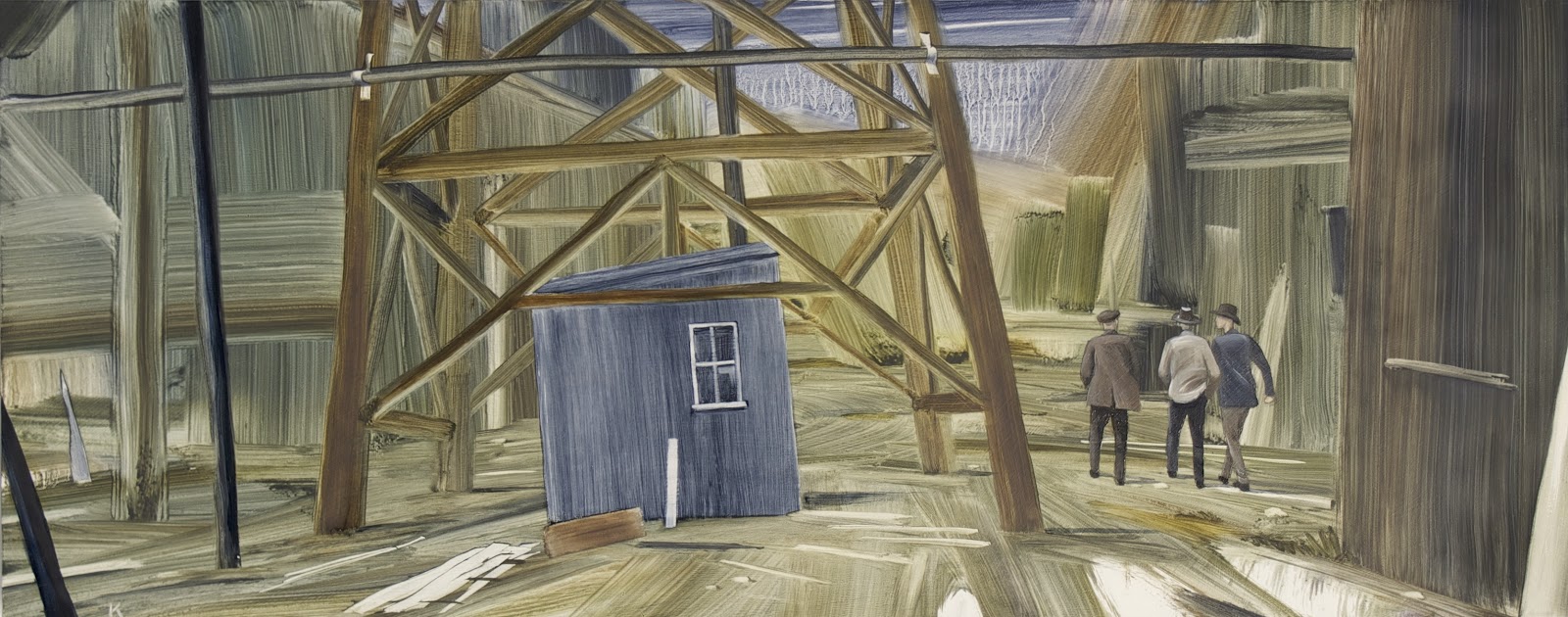
The Golden Cross mine
63 x 25
At Waihi, Tim Armstrong found work at the
Golden Cross mine. “There they had a union and it was the very thing I
wanted.” In no time at all Tim was president of the large Waihi Miners Union.

Bill Parry
180 x 45
The Waihi Miners Union managed to retain a
president by paying his salary themselves, and Bill Parry proved his worth
during fierce negotiations with the mining company over competitive
contracting.

The Rebel
40 x 60
Charles Smith was a “Niagara of Energy”. He
was a miner, the president of the local branch of the Socialist Party, the
author of frequent articles on Waihi, under the pen-name ‘The Rebel”, and the
organiser of Pat Hickey’s 1911 campaign for the parliamentary seat of
Ohinemuri.

Pat Hickey
Private collection
By 1911 this ‘roaring
boy’ from the Federation of Labour was one of the country’s most powerful
political orators. The Waihi socialists selected him as their candidate for the
1911 general election.

Bob Semple
Private Collection
Known as ‘Bob the Ranter, a former
tunneller and one of the country’s prominent apostles of socialism, Semple
helped to campaign for Hickey in Waihi.

Paddy Webb
Private collection
While Hickey ran for parliament in Waihi,
Paddy Webb was the miners’ choice in Runanga on the west coast. Neither man won
in 1911, but in 1913 Webb won a by-election to become the first coalminer to
enter parliament.

Harry Holland
55 x 40
Harry was a silver-tongued Australian
radical who was invited to New Zealand by the Waihi socialists to give a
speaking tour. He stayed here for the rest of his life and became leader of the
Labour Party.

Marjorie Noakes
55 x 40
A schoolgirl and miner’s daughter who, like
Zena Norton, was passionate about the principles of her father’s union. “Why
should men who work the hardest get the smallest pay, and those who do not work
at all get millions of money?”

The mine manager’s dream
122 x 90
With the water level rising in the
mineshafts and returns falling for the first time in a decade, industrial
conflict threatens to overwhelm the diggings and the embattled mine manager
sleeps uneasily.

Two on the beats and one in the watchhouse
Three panels, each panel
17 x 26
“Since the Strike commenced, there have
been three Constables on night duty, two on the Beats and one in the
Watchhouse.”

The police inspector’s report
55 x 40
“I beg to report that ever since the Strike
commenced… not one act of lawlessness of any kind has been committed”

The Cornish Pumphouse
120 x 90
This concrete castle housed
the massive pumps that kept the mines free of water. During the strike they
fell silent, and several strikers slipped underground to check how high the
water levels had risen.”

Rev. Robert Cleary
55 x 40
The local Anglican minister was one of
several Waihi notables who signed a letter calling for the government to
intervene in the strike. He was later made an honorary member of the scab
union.

Commissioner Cullen
90 x 90
An iron-willed Irishman who rose from
constable to Commissioner of Police, Cullen was prepared to break his own laws
to defeat Waihi strikers and other ‘enemies of society’.

Bully boys and ex-cons
55 x 40
“the peace of Cullen the Police
Commissioner and Herdman the voice of Justice, who sent in extra cops,
scabs, bully boys and ex-cons”

The Snakecharmer
55 x 40
If there was trouble in Seddon Street,
Waihi’s main thoroughfare, the sinister bowler-hatted strikebreaker known as
the Snakecharmer was always there.

Harvey the Pug
55 x 40
The vicious ex-criminal recruited to help
break the strike, he rode into town firing a pistol in each hand.

Hatpin Delaney
55 x 40
The blustering strikebreaker who gained his
nickname after he was chased by 18-year-old Jessie Beames, armed only with the
nine-inch hatpin she pulled from her cascade of chestnut hair.

The brakes
120 x 90
Strikebreakers were transported to and from
the mine in open horse-drawn carriages, known as brakes. Sometimes a uniformed
policeman held the reins. On every shift they faced a barrage of abuse from
strikers and their families.

The Death of Fred Evans
32 x 23
Evans then fled in terror through a back
door and into a vacant property behind the hall. “My father always said that he
survived,” says Don Boswell, “because he could run faster than Fred Evans.”

Michael Rudd
55 x 40
The turncoat from the strikers’ ranks who
compiled a list of his former colleagues. The strikebreakers worked through the
list, giving each man and his family a day’s notice to be on the train out of
town.

Georgina Parry
13 x 15
Georgina Parry, wife of the imprisoned
union president, was threatened by a mob. “I said if they were men enough to
attack me, I was woman enough to fight them.”

Peter Fraser
55 x 40
55 x 40
The earnest Scot from the Federation of
Labour who got Bill Parry released from Mt. Eden gaol. Like others prominent in
the strike, Fraser entered parliament 20 years later.

The Scarlet Runners
120 x 40
Private Collection
The strikers’ sweethearts, wives and sisters who ran messages through police lines and later slipped into the besieged town to distribute relief supplies.
The strikers’ sweethearts, wives and sisters who ran messages through police lines and later slipped into the besieged town to distribute relief supplies.

The Taniwha
112 x 20
The river steamer that sailed between
Paeroa and Auckland, carrying strikers, strikebreakers and gold. In November
1912 it transported the terrorised strikers’ families to safety.
The quotations with each painting are from
“Waiheathens – Voices from a mining town,” by Mark Derby and Bob Kerr. A book
that accompanies this exhibition. This book can be bought from the Waihi
Gallery or from the publisher, Atuanui Press. atuanuipress.co.nz

The paintings are all oil on board. Their
dimensions are in cm, width before height. If you are interested in purchasing
any of these paintings please contact:
54 Kenny St Waihi
Box 149 Waihi 3641
When they are showing in Rotorua and
Auckland please contact:
12 Crummer Rd. Ponsonby
Auckland, New Zealand
Email: dwhite@whitespace.co.nz
Phone : +64 9 361
6331
Mobile: +64 21 639 789.
The show will travel in its complete state
and works purchased from Waihi or Rotorua will be delivered at the conclusion
of the showing at Whitespace in July.
Subscribe to:
Posts (Atom)